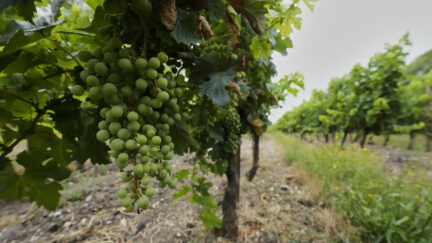
Senators Take Aim at Invasive Pest Threatening East Coast Wine Industry

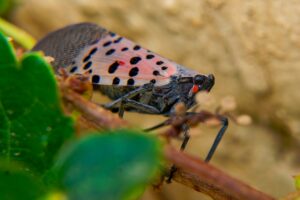
Lycorma delicatula sits on an ivy stem at a country garden in Sangju, South Korea, on August 18, 2026. (Photo: Seung-il Ryu/NurPhoto via AP)
Senator Kirsten Gillibrand (D-NY) has joined forces with a bipartisan coalition of lawmakers to contain an outbreak of spotted lanternflies, an invasive planthopper wreaking havoc on the Northeast’s wine industry.
Last week, Gillibrand introduced the Spotted Lanternfly Research and Development Act, legislation that would designate the insect as an invasive species and place it as a high-priority research initiative for the USDA’s National Institute of Food and Agriculture. The bill cites a 2025 Cornell University study, which found that spotted lanternflies could cost New York’s grape industry over $14 million in three years if left unchecked.
The insects are easily identified by their grayish-tan forewings and bright red bodies. Though they pose no immediate danger to humans or animals, spotted lanternflies damage plants by sucking sap and leaving behind a waste product that attracts black mold. The planthoppers have thus far been sighted in 19 states and the District of Columbia, with the largest established populations in Pennsylvania, New York and New Jersey.
“The spotted lanternfly has proven to be a destructive pest that threatens New York State’s specialty crops, especially vineyards throughout Western New York, the Finger Lakes, Long Island and the Hudson Valley,” Gillibrand said.
She continued: “If not contained, this pest will have devastating economic consequences at a time when New York farmers are already having their profits destroyed by rising diesel and fertilizer costs. Congress must immediately prioritize spotted lanternfly research to prevent further spread.”
Gillibrand initiated the bill alongside Senators John Fetterman (D-PA), Dave McCormick (R-PA) and Ron Wyden (D-OR). Senate Minority Leader Chuck Schumer previously voiced his support for the cause, pushing the USDA to spend over $200 million on education and eradication.
Spotted lanternflies first appeared in the New York area in August 2020. Originally native to regions in China, Taiwan and Vietnam, it’s believed that eggs were accidentally introduced to the US in the mid 2010s through imported shipments of wood and stone. Spotted lanternflies were similarly introduced to South Korea in 2004 and rapidly spread to encompass much of the country within five years.
The insects are known to feed on over 70 plant species and are frequently found covering tree trunks in an impenetrable swarm of grey and red.
Since spotted lanternflies lack natural predators in North America, officials have encouraged the public to take matters into their own hands. Several municipalities have offered financial incentives to locals who squash and photograph dead lanternflies, while others have hosted “Big Squish” community events in high-infestation areas.
Gillibrand’s legislation does not outline a specific plan of action. Instead, it would facilitate research and extension grants that could be used to fund education and treatment at the USDA’s discretion.
Follow The Daily Pour:
About The Daily Pour
Founded by Dan Abrams, The Daily Pour is the ultimate drinking guide for the modern consumer, covering spirits, non-alcoholic and hemp beverages. With its unique combination of cross-category coverage and signature rating system that aggregates reviews from trusted critics across the internet, The Daily Pour sets the standard as the leading authority in helping consumers discover, compare and enjoy the best of today's evolving drinks landscape.