A SpaceX Mission Could Send Whisky Into Orbit for 5 Years

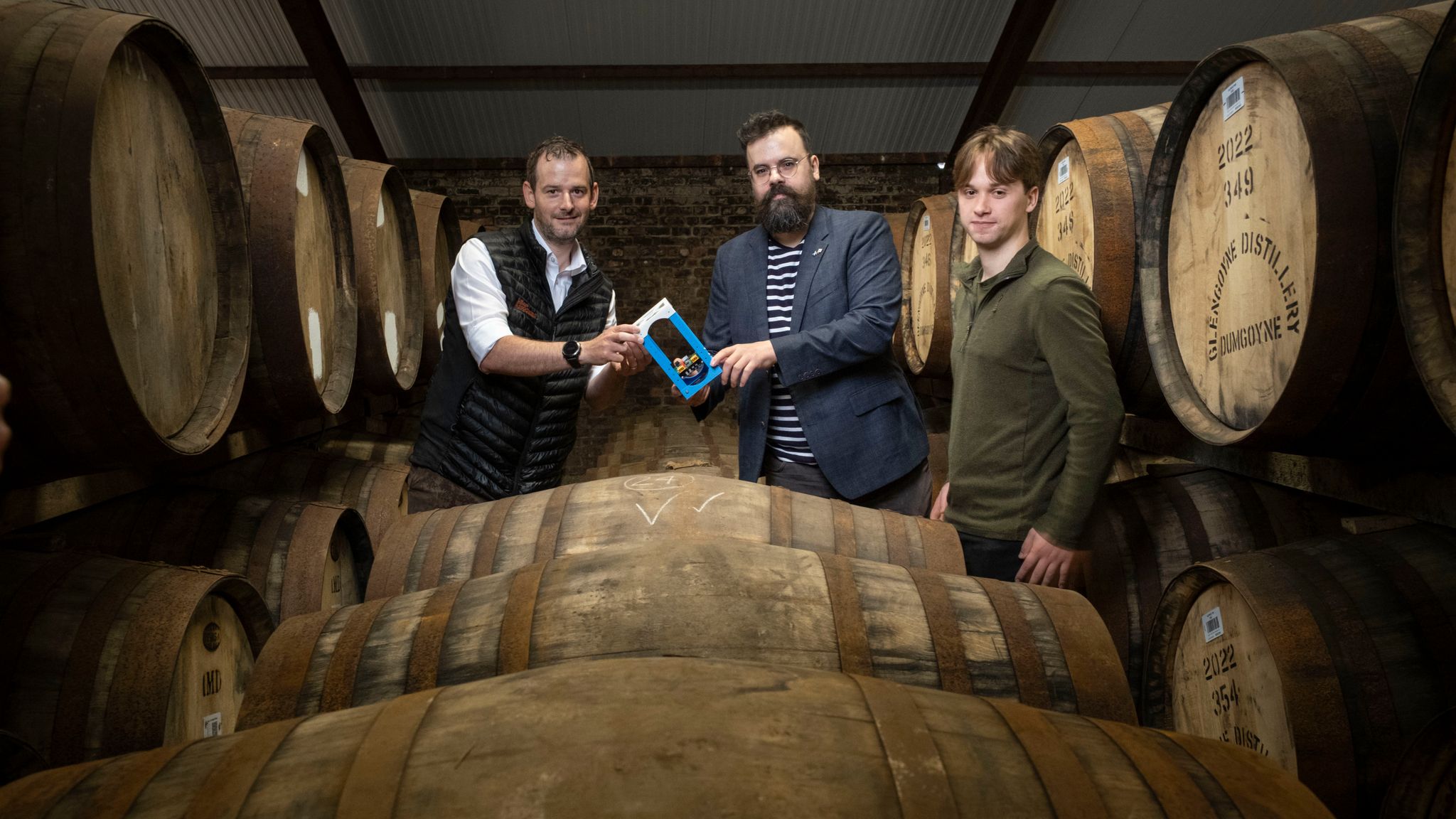
From left to right: Geoff Nisbet, Dr Gilles Bailet and Micah Chapman. (Photo: University of Glasgow/Chris James/PA)
Whisky could soon get an out-of-this-world aging experiment.
Scientists from Scotland and Japan are developing a small satellite that could send whisky samples and base ingredients into orbit in 2028, where researchers will study how extreme temperature changes and the space environment affect whisky maturation.
The experiment, nicknamed “Space Puffin,” is being developed by engineers and scientists from the University of Glasgow and Japanese partners. The current plan calls for the CubeSat to travel on a SpaceX supply mission to the International Space Station before being deployed into orbit from the station’s Japanese module, according to LBC.
Once in orbit, the satellite is expected to remain there for five years. Scientists will monitor the whisky samples and transmit data about their color and chemical composition back to Earth.
The goal is to better understand how whisky matures and whether the conditions of space could accelerate some aspects of the aging process.
“We build our spacecraft to be able to get an environment which is better for the whisky, but this wood will breathe faster than on Earth,” Dr. Gilles Bailet of the University of Glasgow said, according to LBC. “And so we are hoping that we’ll be able to accelerate the ageing to be able to get something more interesting.”
How Space Could Change Whisky
Whisky maturation depends partly on the interaction between the spirit and the wood used during aging. The Space Puffin experiment will use small wood chips with liquid whisky samples to mimic elements of the cask-aging process.
The samples will experience repeated shifts between extreme heat and freezing temperatures as the satellite orbits Earth roughly every 90 minutes.
Researchers hope those changes could affect how the spirit interacts with the wood and potentially produce chemical changes that differ from traditional maturation on Earth.
The team will monitor the samples remotely rather than bringing the CubeSat back to Earth. The satellite is not expected to be recovered at the end of its five-year mission.
The project also aims to study the extraction of ethanol in orbit. Ethanol is used in the production of whisky and has applications in pharmaceuticals and other industries.
Bailet said the team wants to eventually go beyond small experimental samples.
“We are really keen to be able to actually fly a full whisky-making system, with a full cask, if we’re able to collaborate with investors or other people interested about it,” he said, according to LBC. “But it’s totally in the realm of possible to bring back something like a litre of whisky within the next three to five years.”
Space Puffin would not be the first whisky experiment to leave Earth.
In 2022, Monkey Shoulder sent a bottle of Scotch into the stratosphere aboard a weather balloon as part of a music video project supporting the live music industry. The bottle’s journey was filmed for the video for “Lit Up.”
That same year, The Glenlivet sent barley seeds to the International Space Station aboard a SpaceX rocket as part of a University of Guelph experiment studying how crops respond to space conditions. The seeds later returned to Earth and were intended for planting, malting and distillation into whisky.
The bourbon industry has also pursued orbital aging. In 2023, North Carolina’s Mystic Farm and Distillery announced plans for its Mystic Galactic Bourbon, which was designed to spend a year aging in orbit inside specially modified barrels.
Those projects differ from Space Puffin. The new experiment is designed primarily as a scientific study of whisky maturation, using small samples and wood chips rather than attempting to produce a commercial space-aged spirit.
If the experiment goes ahead as planned, Space Puffin could provide researchers with new data on how whisky, wood and ethanol behave outside Earth’s atmosphere.
Bailet sees a potential path from the small CubeSat experiment to a much larger system capable of sending a full whisky cask into orbit.
He expects the unusual maturation environment could eventually produce “very bold” whiskies with complex flavor profiles.
For now, however, the researchers are focused on the science. If the 2028 launch happens as planned, Space Puffin could offer a closer look at whether the final frontier can change how Scotch whisky ages.
Follow The Daily Pour:
About The Daily Pour
Founded by Dan Abrams, The Daily Pour is the ultimate drinking guide for the modern consumer, covering spirits, non-alcoholic and hemp beverages. With its unique combination of cross-category coverage and signature rating system that aggregates reviews from trusted critics across the internet, The Daily Pour sets the standard as the leading authority in helping consumers discover, compare and enjoy the best of today's evolving drinks landscape.