Leiper’s Fork Distillery Is Poised to Take Its Biggest Swing Yet, Bringing Craft Whiskey to Downtown Nashville

A family-owned distillery in Williamson County is opening a 7,000-plus-square-foot bar, restaurant and working distillery in one of downtown Nashville’s fastest-growing districts.
For many distilleries, efficiency, margins and profits are everything, especially in a time where Americans are drinking and buying less alcohol than they were a few years ago, and wallets have tightened across the industry. Franklin, Tennessee craft whiskey producer Leiper’s Fork Distillery is betting on the opposite approach.
“We could save ourselves a lot of money if we bought our grains from Cargill and bought our malt from BSG, but that’s not the way I want to do things,” Lee Kennedy, the distillery’s owner and chief distiller, told us on a sunny day in Franklin during a visit to the distillery and a couple of the farms its grains come from.
That stubborn refusal to compromise quality to save money — which the brand calls “inefficient by design” — is the throughline at Leiper’s Fork, and it is about to get a much bigger audience. The distillery is opening a new location at Nashville Yards, a 19-acre downtown development that will include four hotels with roughly 2,000 rooms, an indoor live music and event venue called The Pinnacle, bars and restaurants aplenty, shops and more.
The team is hoping to open the new Leiper’s Fork location in mid-January.
What’s Coming to Nashville Yards
The space at 21 Platform Way S. will run 7,200 square feet, with another 2,500 downstairs. It will hold a full-service bar and restaurant, a working still, tours and tastings, a retail shop, private dining, event space and live music. The tasting room will be named for Samuel Claybrook Locke, a Locke family ancestor and Prohibition-era federal agent tied to the distillery’s history.
Devin Walden will lead Leiper’s Fork’s distillation efforts at the Yards location, operating a 250-gallon version of the one at the main distillery, designed exactly like Leiper’s Fork’s original swan-neck still, just half the size. It will make whiskey from Leiper’s Fork’s usual mashbills, though Walden — a Kentucky native who previously served as master distiller at Big Machine Distillery and worked at Woodford Reserve — plans to experiment with small runs of other liquors, as well. Her approach may look like a scaled-up version of what Sterling Rogers, head distiller at the distillery’s House of Spirits bar in downtown Franklin, does on a 50-gallon still there. Rogers is working on rums now and has distilled small runs of various liqueurs, plus vodka, limoncello and more.
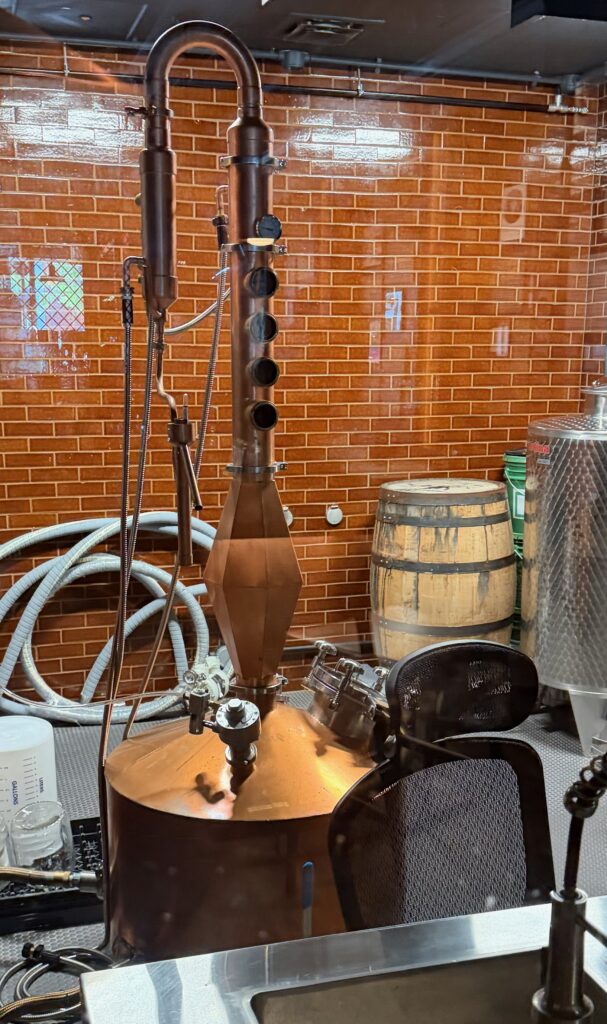
The still at Leiper’s Fork’s House of Spirits in Franklin, Tennessee.
The restaurant will lean Appalachian with a focus on local sourcing. The culinary program is led by Davis Reese, a talented chef who has had stops at a smattering of Nashville restaurants: Arnold’s Country Kitchen, Husk, Continental, Audrey and June. He also co-founded Joyland alongside James Beard Award-winning chef Sean Brock.
Downtown Nashville draws roughly 16 million visitors a year, and Nashville Yards is the city’s first open-container district; a distillery will fit right in. Kennedy tells us that Leiper’s Fork didn’t go looking for the deal. The Yards’ developers reached out to the distillery unprompted in July 2024, and construction is underway.
About Leiper’s Fork, a Distillery in the Hills of Williamson County
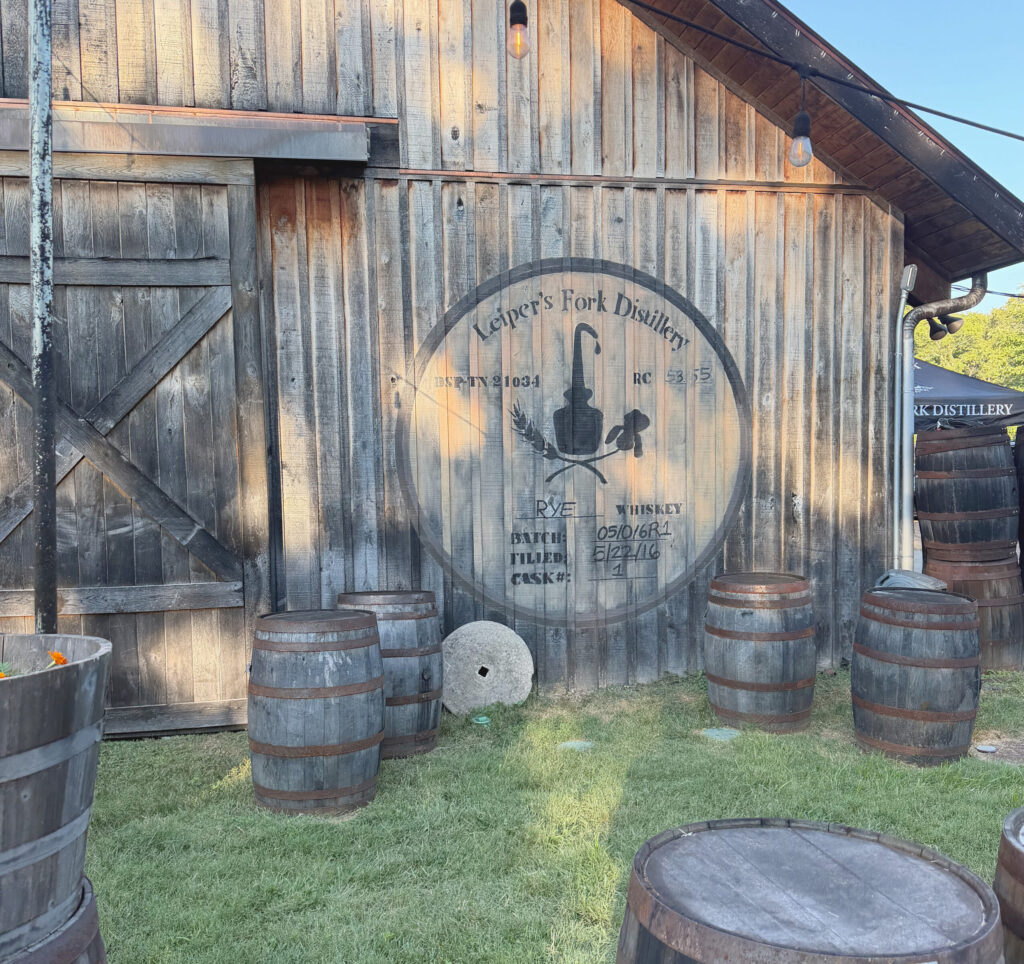
The original distillery sits on 27 acres just outside the village of Leiper’s Fork, with a 200-year-old log cabin that serves as the tasting room and a timber-framed stillhouse next to it. Inside is a 500-gallon Scottish-style copper pot still. Kennedy founded the distillery in 2016 with his family.
Kennedy built his first still in his mother’s basement as a teenager, something that he jokes he’ll only admit because the statute of limitations has expired. Prior to 2016’s opening, he spent three years working to change Williamson County law so he could open a commercial distillery.
Milling and charcoal-burning for the distillery’s own Lincoln County Process both happen away from the distillery, but not too far, near Kennedy’s house. The offsite milling, Kennedy says, is probably the only one of the distillery’s inefficiencies that isn’t by design. It’s just how they set the operation up in the early days, and it’s how they still do it today.
Grain to Glass
The grain is where the inefficiency is most visible. Leiper’s Fork buys its corn, rye and barley from nearby farms, such as Walnut Grove Farms in Schochoh, Kentucky, about 50 miles north of Nashville, as well as Franklin-area farms River Bound and River Grange.
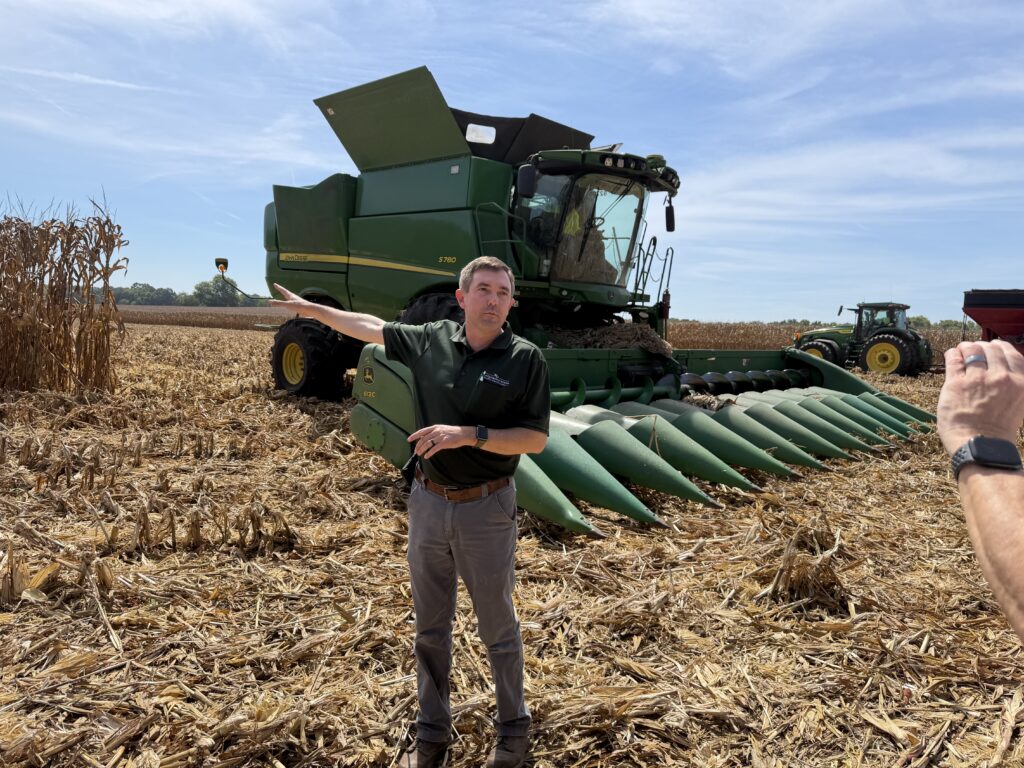
Sam Halcomb
Sam Halcomb, who raised the family’s grain and hog operations at Walnut Grove, started growing non-GMO corn specifically for Leiper’s Fork.
“The good thing about Sam and working with him is we can take a bottle off the shelf and track the grains back to the field that it was grown in,” Kennedy says. “Having that level of control is super important to us.”
Halcomb sells his raw barley to Riverbend Malt House in North Carolina, which malts it and sells it to the distillery. Riverbend kiln-toasts its barley, a Vienna-style malt. Leiper’s Fork distills three core mashbills: Tennessee whiskey (70% corn, 15% rye, 15% malted barley), Bourbon (70% corn, 15% wheat, 15% malted barley) and Rye Whiskey (55% rye, 30% corn and 15% malted barley).
That barley percentage is unusually high. Many American distilleries use as little barley as they can — just enough so that the malt does its job in breaking down grain starches into fermentable sugars. Kennedy says they use more barley — and spend more money to have it toasted — because the distillery treats it as a true flavor grain, not just an enzyme source.
Rye is the tougher crop. “It’s really tough to grow rye and barley in the south, but Sam has figured it out,” Kennedy says.
Halcomb explains why: Rye fell out of favor in Kentucky and Tennessee around Prohibition, when corn and later soybeans had stronger demand, and so the research fell behind. “The rye that we’re growing was really adapted for maybe Canada or maybe Europe, but not adapted for here,” he said. “So, we’re trying to overcome that. And even though wheat, barley and rye are all similar, the management practices are not exactly the same, so we’re having to learn as we go, because there’s not really a modern-day guidebook of how to grow good rye for grain.
“We’re making a lot of progress — but it’s a slow process.”
The distillery is in the process of joining the Estate Whiskey Alliance, a group that certifies whiskeys made from grain grown on estate-owned or controlled land and produced entirely on site.
How Leiper’s Fork Makes Its Whiskey
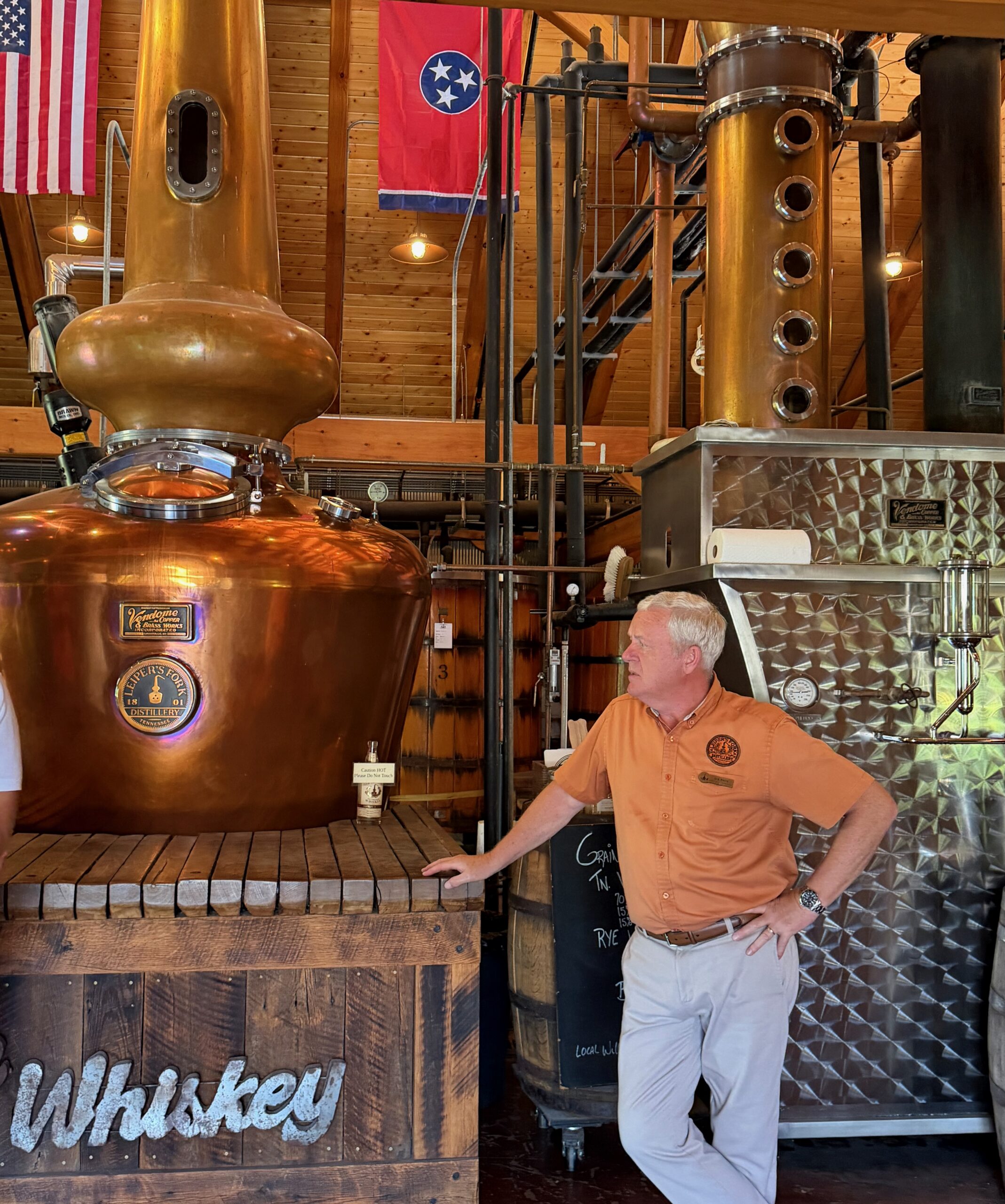
Leiper’s Fork Head of Tours & Education Paul Bissett leads a tour in front of Leiper’s Fork’s still.
The distillery makes whiskey using the sweet mash process, meaning no backset — acidic liquid strained from a previous batch — goes into the fermenter. That puts Leiper’s Fork in the minority. Most large producers and a number of bigger craft distillers use sour mash instead, adding backset to control pH and guard against bacterial contamination during fermentation. It’s the method that built brands like Jim Beam and Jack Daniel’s, and it delivers a dependable consistency: Each new batch carries some flavor influence from the one before it.
Sweet mash trades some of that built-in insurance for more control. Without backset shaping the batch, distillers are working with a cleaner slate each time, which many sweet-mash producers believe gives them more control in shaping flavor.
The whiskey comes off the still at 137 proof. It enters the barrel, all new American oak, at 110 proof, well below the legal maximum of 125. Many distilleries fill closer to that ceiling because it’s cheaper — dropping to 110 means adding more water before filling, which means more volume and more barrels. In my experience, lower fill proofs often produce a more flavorful, open and lush whiskey. Paul Bissett, who leads tours and education at the distillery, told us about a Seagram’s study that found 110 to be the most efficient proof for flavor extraction.
The distillery calls this a “preprohibition” style, a phrase that covers the sweet mash and the barrel entry proof. They use whiskey to start the charcoal fire for the Lincoln County Process and check proof with hydrometers. “Everything’s sort of a tribute to a throwback way of doing things,” Bissett told us.
A Memorable Tour and Tasting
Bissett — a Scotsman, former William Grant & Sons brand ambassador, veteran of the British Royal Navy and the author of nine books about whisk(e)y — is a true asset to Leiper’s Fork. He’s funny, deeply knowledgeable and skilled at making the process easy to follow for tourists of any knowledge level. He packs together information and entertainment at a level rarely found at American distilleries. If you visit the distillery, book a tour with him.
During our visit, Bissett and Kennedy led a tasting at the distillery in which we sampled Leiper’s Fork’s Old Natchez Tennessee White Whiskey (the distillery’s “white dog,” which is unaged whiskey), Bottled-In-Bond Bourbon, Bottled-In-Bond Tennessee Whiskey, a single-barrel rye and a distillery-exclusive bourbon finished in a maple cask. I enjoyed them all. It’s fun to go back and forth between the bourbon and Tennessee whiskey and see the difference 15% rye vs. wheat makes in the mashbill, as well as what changes the Lincoln County Process (charcoal filtration) has on the Tennessee whiskey.
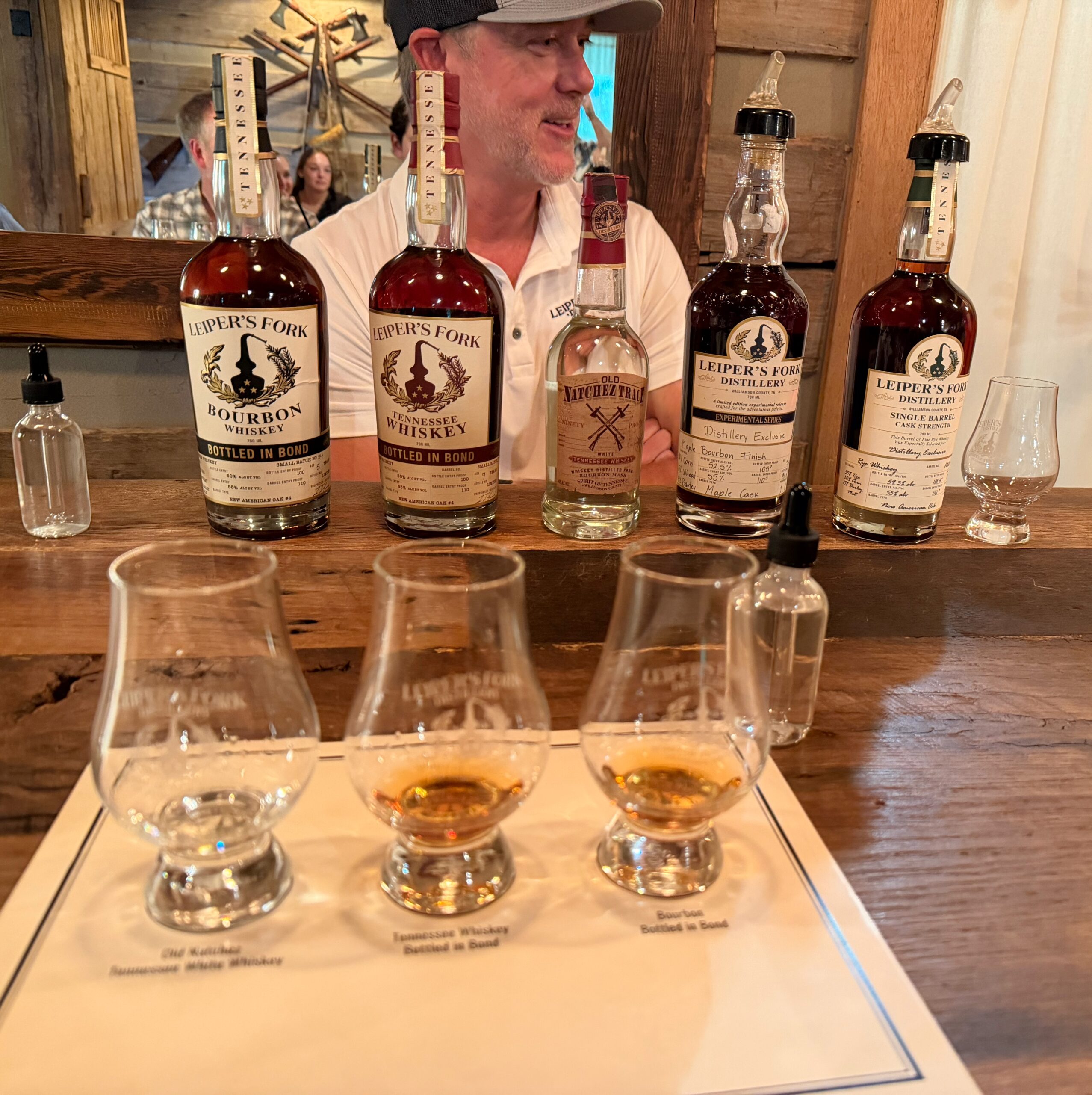
Leiper’s Fork Owner and Chief Distiller Lee Kennedy helps guide a tasting at the distillery.
My favorite pour of the trip, though, came at Kennedy’s house, following a delicious lunch catered by Reese. Before we left, Kennedy poured a few glasses of a 7-year and 1-month-old single-barrel rye (barrel No. 32). It was jammy and spicy, filled with notes of clove, cinnamon, blackberry and cherry cola. Whatever made that whiskey so good — perhaps it was the fact that the bottle was half-empty, giving the remains plenty of time to aerate, or perhaps it was just a special barrel — it was a truly outstanding rye.
What’s Next
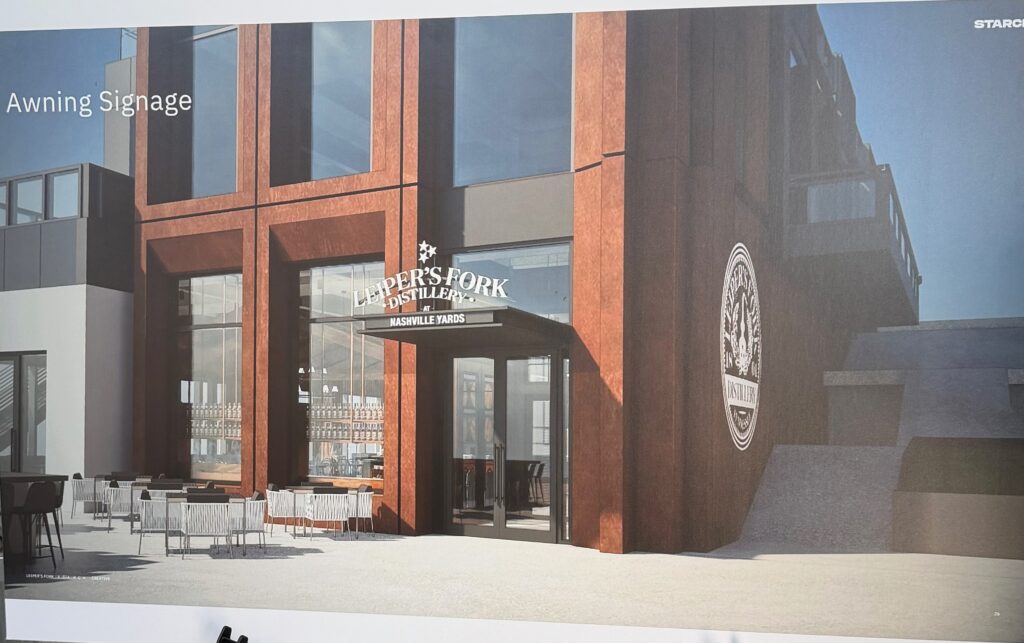
A rendering of the exterior of the forthcoming Leiper’s Fork location at Nashville Yards.
As it nears its 10th anniversary in October, Leiper’s Fork is readying itself for its biggest expansion yet. It already runs the distillery in Leiper’s Fork and House of Spirits on Main Street in downtown Franklin, a bar and gathering space with private tastings in an upstairs library. Nashville Yards will put the brand in front of far more people, in a market where visitors are looking for a Tennessee whiskey that isn’t a household name. The bet is that they’ll find one worth the trip.
Follow The Daily Pour:
About The Daily Pour
Founded by Dan Abrams, The Daily Pour is the ultimate drinking guide for the modern consumer, covering spirits, non-alcoholic and hemp beverages. With its unique combination of cross-category coverage and signature rating system that aggregates reviews from trusted critics across the internet, The Daily Pour sets the standard as the leading authority in helping consumers discover, compare and enjoy the best of today's evolving drinks landscape.