Does Absinthe Make You Hallucinate? What We Know


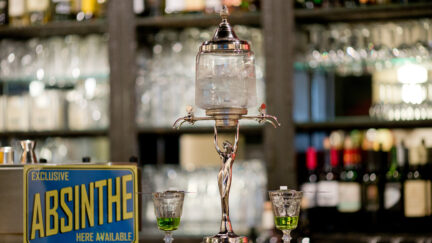
Does absinthe make you hallucinate? (Photo: GDA via AP Images)
Absinthe derives its name from a type of wormwood species called Artemisia absinthium. This green liquor’s notorious reputation partially stems from the fact that bohemian artists in the 19th century believed it held hallucinogenic properties due to wormwood’s presence in the drink.
But does absinthe make you hallucinate?
How Did Absinthe Become Linked to Hallucinations?
Absinthe’s infamous link to hallucinations dates back to the late 1800s in Paris. At the time, an outbreak of phylloxera destroyed nearly all of the vineyards in France, leading to a price increase for the typical glass of wine. Because of this, absinthe became the beverage of choice.
Due to its hefty proof, which typically ranged from 90 to as high as 150 proof, absinthe was favored by the working class because it was strong and gave the drinker a bit more of a bang for their buck. Starving artists also loved the stuff because it was cheap and got the job done.
Artists and Illustrators reports that famous painters of the time, such as Vincent Van Gogh, Pablo Picasso and Toulouse Lautrec, partook in “green hour,” an hour of the day devoted to absinthe consumption. Eventually, absinthe served as a sort of symbol of the bohemian lifestyle, and artists claimed the “green fairy” would pay them a visit, delivering them a source of inspiration — or hallucinations.
Absinthe’s psychedelic reputation significantly helped drive sales, and the drink’s infamous reputation was probably beneficial from a marketing standpoint. Until it wasn’t. In popular culture, absinthe was something linked to creativity, artists, eccentrics, outsiders and qualities that a lot of people didn’t understand — and people tend to vilify things they don’t understand.
Absinthe consumption began to divide the population, and a moral panic about its consumption ensued. Some scientists linked the substance to violence, mental illness and “absinthe madness.”
According to The Spirits Business, the famous poet Paul Verlaine was an avid absinthe drinker. Alcoholism eventually led to his demise, and he blamed absinthe, damning it on his deathbed and calling for that the government to ban absinthe consumption.
In 1905, a man named Jean Lanfray murdered his pregnant wife and two daughters after consuming an excessive quantity of wine, hard liquor and absinthe. Authorities ended up blaming the green fairy for Lanfray’s bouts of violent rage, and a moral crusade against the beverage began, leading to an all-out ban that would last almost 100 years.
What Chemicals Are in Wormwood?
The National Library of Medicine reports that wormwood contains multiple chemical compounds including y-terpinene, 1,4-terpinol, myrcene, cadinene camphene, trans-sabinyl acetate and far too many others to mention. Yet perhaps the most important chemical — at least regarding hallucinations — is the chemical compound called alpha-thujone.
Alpha-thujone is considered toxic, according to the National Library of Medicine. This chemical apparently has insecticidal properties. European Medicines Agency reported on studies done with this chemical component, and claimed that when thujone was administered to rats it led to “epileptiform convulsions” in a single dose. A study showed that when rats were exposed to multiple doses of alpha-thujone, they died. The study reported that certain cases have shown “severe intoxications in humans” after taking oils rich in this chemical component.
One such scientist by the name of Valentin Magnan sought out to prove the link between alpha-thujone and epileptic seizures in the early 1900s. According to VinePair, Magnan studied 250 alcoholics. The control group had alcohol use disorder but did not consume absinthe. The other group drank absinthe to excess. Magnan’s findings implied that those who consumed absinthe in hefty doses suffered from seizures and hallucinations. Yet, Magnan had his own biases to contend with. He had negative views on absinthe which might have influenced his findings — there was a moral crusade against the stuff going on at the time after all.
When the absinthe ban was lifted in the early 2000s, the United States Customs and Border Protection only allowed “thujone free” absinthe. It also mandated that graphics on absinthe bottles can’t project “images of hallucinogenic, psychotropic or mind-altering effects.”
So, Does Absinthe Make You Hallucinate?
No. Absinthe does not make you hallucinate. Though the chemical component thujone could cause epileptic fits, it is highly unlikely that absinthe will make you suffer any hallucinations.
Bon Appétit reports that the only way to potentially hallucinate or experience those epileptic fits would be to get “dead-drunk” to experience these fits. The outlet additionally reports that thujone is found in common herbs like sage, which people use in cooking all the time — and consume in copious quantities, without hallucinations.
In short, absinthe and the correlation between hallucinations is just a myth that contributes to the lore around the spirit. One could argue these claims of “absinthe madness” and “the green fairy” are examples of an early 1900s marketing ploy gone wrong, or evidence of the simple fact that it’s not easy being green.
Follow The Daily Pour:
About The Daily Pour
Founded by Dan Abrams, The Daily Pour is the ultimate drinking guide for the modern consumer, covering spirits, non-alcoholic and hemp beverages. With its unique combination of cross-category coverage and signature rating system that aggregates reviews from trusted critics across the internet, The Daily Pour sets the standard as the leading authority in helping consumers discover, compare and enjoy the best of today's evolving drinks landscape.