Court Rules Nonalcoholic Beverage Cannot Be Labeled as ‘Gin’

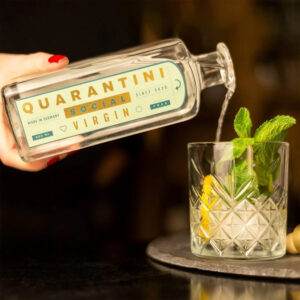
(Photo: Quarantini)
The nonalcoholic spirits industry is projected to reach a market value of over $1 billion in the next decade — but not everyone is satisfied with the fine print. Or, in this case, the large print.
Last week, the Court of Justice of the E.U. ruled that nonalcoholic drinks cannot be labeled as gin. The decision followed a complaint from unfair competition association Verband Sozialer Wettbewerb, which filed a case against PB VI Goods and its product, Virgin Gin Alkoholfrei. PB VI Goods argued that the inclusion of “Alkoholfrei” (“alcohol-free”) clearly differentiated its product from booze. Luxembourg judges were unswayed, saying that the alcohol-free description was “irrelevant” so long as the legal term “gin” was used.
The court maintains that any product labeled as a gin must be produced with ethyl alcohol and juniper berries, with a minimum alcohol content of 37.5% ABV. Though nonalcoholic, juniper-infused products are still perfectly legal, companies like PB Vi Goods are now compelled to omit “gin” from any of their marketing materials.
The Gin Guild, a coalition of distillers and industry leaders based in the U.K., applauded the ruling, saying that it will “build value and reputation” for the global market “without unfair competition from look-alike products.”
“We welcome this decision – it upholds integrity in the gin category and protects producers who invest in the craft of gin distillation. It means the word ‘gin’ remains a meaningful guarantee of alcohol-based botanical spirit, rather than a marketing label for a very different product,” Pal Gleed, Director of the Gin Guild, said in a public statement.
The ruling does not pertain to nonalcoholic gins produced outside of the E.U. Nor is it clear how the ruling might theoretically effect certain labels were they produced within its jurisdiction. Ritual Zero-Proof, for instance, is a leading nonalcoholic spirits manufacturer based in Chicago, Illinois, where one its flagship products it manufactured and sold under the name Ritual Zero-Proof Gin Alternative.
Would a self-professed gin alternative — by definition, the absence of gin — fall under the legal umbrella? The courts will be left to decide in years to come.
Our Take
The court’s decision hits at a fast-growing bright spot in the zero-proof space.
Over the past few years, producers have launched nonalcoholic alternatives inspired by whiskey, tequila, rum, aperitifs and just about everything else available on a liquor store shelf. If you ask us, however, zero-proof gins are the only spirit category that have consistently been able to imitate the real thing. Botanicals like juniper and coriander do well to imitate the bitter bite of liquor, especially when it comes to the spicy finish that many consumers associate with conventional spirits.
But the science is catching up quickly. A nonalcoholic whiskey may soon be able to rival a spirit distilled in Kentucky, just as nonalc gins have already done a remarkably good job at approximating their boozy counterparts. As zero-proof spirits inch closer and closer to achieving their goals, we’ll likely begin to see pushback from liquor companies protecting their slice of the pie.
Follow The Daily Pour:
About The Daily Pour
Founded by Dan Abrams, The Daily Pour is the ultimate drinking guide for the modern consumer, covering spirits, non-alcoholic and hemp beverages. With its unique combination of cross-category coverage and signature rating system that aggregates reviews from trusted critics across the internet, The Daily Pour sets the standard as the leading authority in helping consumers discover, compare and enjoy the best of today's evolving drinks landscape.