How a Seasoned Spirits Judge Approaches Judging Non-Alcoholic Beverages

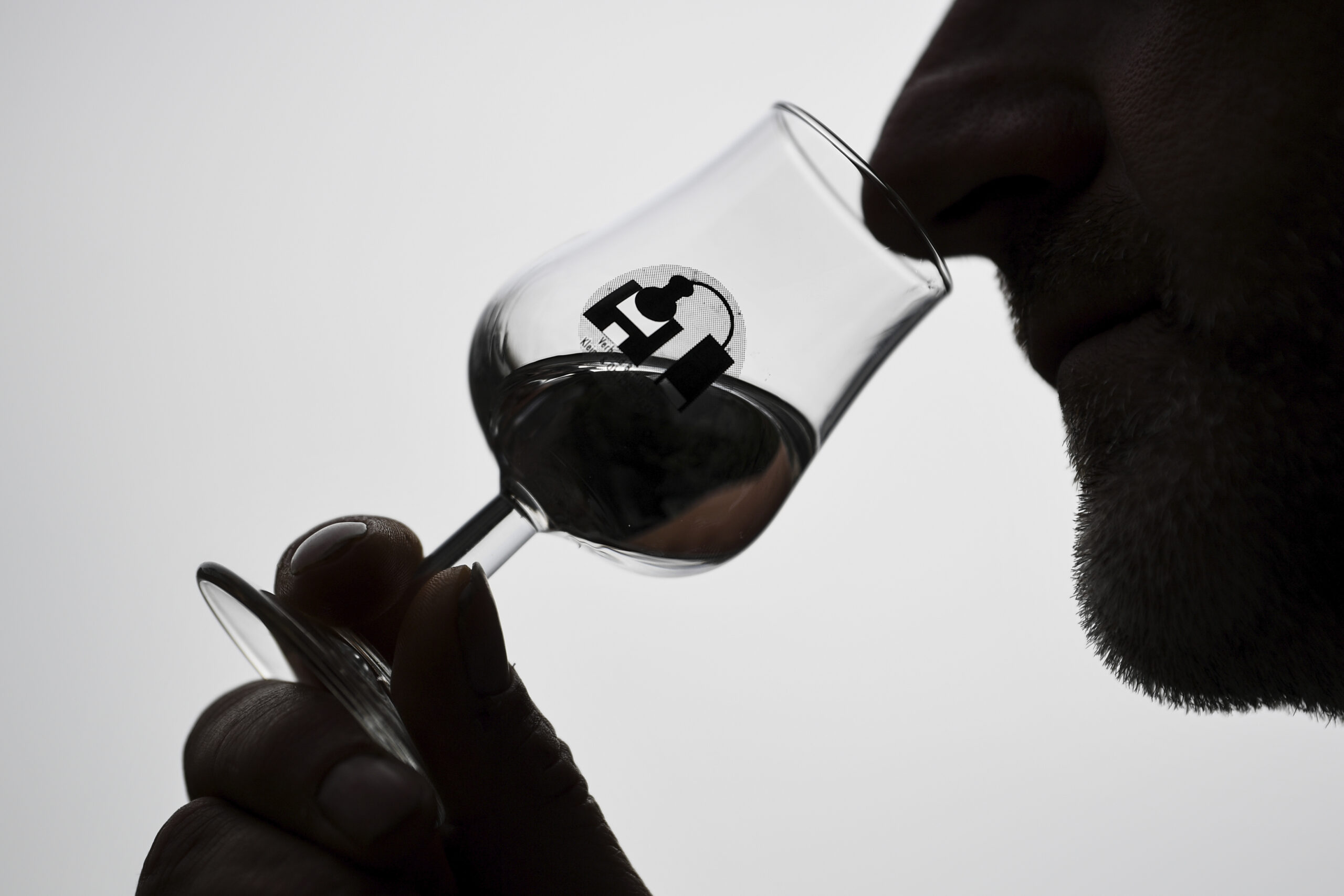
Frank K’chlin, deputy chairman of the Association of Baden’s small distillers and fruit distillers, holding a glass with spirit in his hand on March 26, 2018, in Sasbachwalden, Germany. (Photo: Patrick Seeger/picture-alliance/dpa/AP Images)
I still remember how the viscous liquid, which bore more resemblance to cough syrup than a spirit, coated my mouth with the sting of cinnamon overpowering any other flavor. There was only one option for me as a spirits judge, always a last resort: no medal. It did not deserve to brandish one.
I have been a spirits judge since 2011. During that time, I have tasted and judged just about every category from Bourbon to Baijiu, and I have tasted my fair share of delicious and not so delicious spirits. In spirits competitions, we assign each spirit a medal from bronze to gold (sometimes no medal), indicating the quality of the spirit. Through the years, I developed a framework to judge each spirit.
When I stopped drinking and became focused on no- and low-alcohol spirits and cocktails, I was lucky to have that framework, as it works for non-alcoholic spirits, too. And that framework is what I apply to my work as head spirits judge for the Zero Proof Choice Awards.
The Factors That Matter When Judging Non-Alcoholic Beverages
Normativity
The spirit that coated my mouth and stung my throat with cinnamon was supposedly an apple vodka, a generally crisp and mildly sweet spirit that exhibits first and foremost the flavor of apple — not apple pie, and certainly not cinnamon. The problem was not that this particular producer had made something that tasted bad; it was that it fundamentally missed the mark of the category. Anyone pulling this spirit off the shelf would be confused at their purchase. It was not apple-flavored vodka.
This is first and foremost the decision I use in determining the quality of a spirit: Does it do what it says it does? This is called normativity and more specifically means that: (1) the spirit exhibits legal and normative standards for the product’s respective category, and (2) the spirit exhibits conformity to what the package or labeling implies.
In cases where there are no normative standards, I rely on any other indicator from the label (we are not shown brands since it is a blind tasting but can ask for descriptors from the label). This allows for us to be as fair as possible and not compare a kava-based spirit with a bourbon alternative. Each is judged on their own merits.
In cases where there is no precedent, we rely on the next determinant: Is it delicious?
Deliciousness
The catch is that “delicious” may not necessarily be delicious to my individual palate. That is why we taste in groups. It is not about what I like to drink, per se. It is about a range of palates and experiences. That way we can be more objective about the criteria, not relying entirely on one person’s experience.
Of course, for it to taste delicious it also must be well-made and an outstanding example within its category. More specifically, what that means to me is that it must: (1) exhibit complexity within the parameters of its category; (2) be well-made and free of obvious flaws; and (3) be pleasing to observe, smell, taste and contemplate.
This is the most subjective part, but it still has important markers, and it is more about the totality of the spirit than its constituent parts — color, aroma, taste, etc. We may pick spirits apart to try and discern what they are, but this is where we put them back together and ask a very important question: Would someone enjoy drinking this?
The Judges
One of the key factors in making this framework work is the group of experienced judges who have worked with non-alcoholic spirits before. They have already tasted hundreds of non-alcoholic products before being invited to the competition. Judges like L.P. O’Brien, global creative director of bars for F-1 Arcade and winner of Netflix’s “Drink Masters” Season 1; or Abe Zarate, wine director at the Crane Club restaurant. Studies indicate that these professional tasters process tasting differently. Specifically, they have tasting superpowers, or “superior flavor recognition abilities.”
This of course does not make us perfect, and there are times we get carried away with our subjective experience, which may lead to stalemates, where the group cannot determine the final medal. In these cases, we assign the spirit to a new judging group and compare results. This helps to avoid one person bullying others into changing their minds, though I assure you judges tend to be all strong-minded, meaning this rarely happens.
Our goal is to make sure every medal we assign is as accurate as it can be. It is by no means easy work, sometimes tasting 50 or more spirits a day, but the reward is that we help to shape the nascent category of non-alcoholic spirit into a quality-based category that is recognized for excellence. When you see a gold medal from the Zero Proof Choice Awards, it should mean something.
Follow The Daily Pour:
About The Daily Pour
Founded by Dan Abrams, The Daily Pour is the ultimate drinking guide for the modern consumer, covering spirits, non-alcoholic and hemp beverages. With its unique combination of cross-category coverage and signature rating system that aggregates reviews from trusted critics across the internet, The Daily Pour sets the standard as the leading authority in helping consumers discover, compare and enjoy the best of today's evolving drinks landscape.