‘Extremely Anxiety-Inducing’: Cognac Industry Takes Hit as Tariffs Squeeze Global Sales

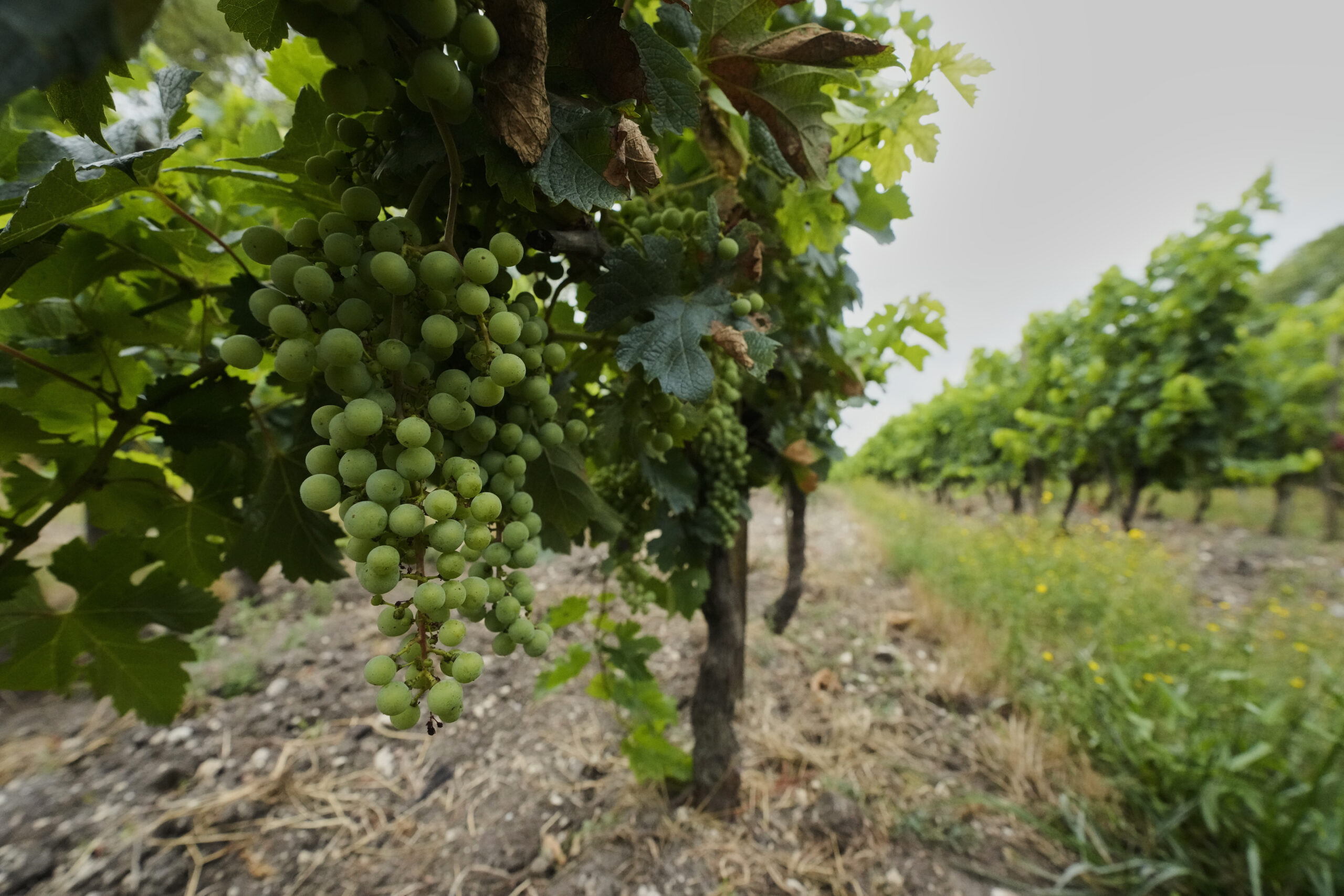
A grape at the Cognac Pasquet vineyard July 23, 2025, in Bellevigne, near Cognac, southwestern France. (AP Photo/Michel Euler)
French Cognac producers are facing another difficult harvest as falling sales in China and the United States squeeze an industry that sends 98% of its production outside the European Union.
Cognac sales have fallen from about 230 million bottles in 2023 to 140 million, according to Euronews. The decline has forced the region’s major Cognac houses to reduce orders from winegrowers after customers canceled contracts.
The four largest houses, Rémy Martin, Hennessy, Martell and Courvoisier, have all been affected by the downturn.
The latest harvest has brought another challenge. Drought has reduced grape yields in the Cognac region, with winegrower Matthieu Augier telling Euronews that the economic impact could amount to a 30% to 40% reduction compared with a typical year.
For an industry already dealing with weaker demand, however, the smaller harvest could help bring production closer to market needs.
“We thought the harvest was going to be promising, but in the end the drought took its toll,” Augier told Euronews.
China Trade Fight Hits Cognac
China was the first major export market to create problems for Cognac producers.
China accounts for about 25% of Cognac exports, making it the spirit’s second-largest market after the United States.
After the EU imposed tariffs on Chinese electric vehicles in 2024, Beijing responded with provisional duties of as much as 34.8% on European brandy.
China later confirmed the measures while exempting major Cognac producers that agreed to sell above undisclosed minimum prices.
Raphaël Delpech, director of the National Interprofessional Cognac Bureau, said the Chinese measures nevertheless changed consumer and distributor behavior.
“Once the Chinese government singled us out and associated us with an anti-Chinese European and French policy, consumers started to distance themselves,” Delpech told Euronews. “The distributors stopped buying our bottles and stopped putting our products on their shelves.”
US Tariffs Add More Pressure
The U.S. market has created another source of uncertainty.
The United States accounts for roughly half of Cognac exports. French Cognac had already faced U.S. tariffs during the Boeing-Airbus trade dispute under Donald Trump’s first presidency, but those duties were later suspended during the Biden administration.
The current trade environment has brought tariffs back into focus.
Under the trade framework reached by the EU and United States in 2025, most EU exports to the U.S. — including Cognac — face a 15% tariff.
European wine and spirits groups have pushed for exemptions, but Cognac producers have yet to secure one.
The uncertainty has also affected U.S. importers, according to Delpech.
“It created an extremely anxiety-inducing environment for all our importers in the US, who, just as in China, eventually came to the conclusion that it was better to bet on something safer than Cognac,” he said.
European lawmakers removed the bloc’s remaining tariffs on U.S. goods covered by the trade agreement in July, allowing Washington and Brussels to continue discussions over possible exemptions from the 15% tariff. Cognac, however, remains subject to the levy.
“I get the impression that not much is moving forward,” French MEP Eric Sargiacomo, deputy chair of the European Parliament’s intergroup on wines and spirits, told Euronews.
Sargiacomo noted that the United Kingdom has secured tariff relief for whisky, while Irish whiskey also received similar treatment from the U.S. in September.
Cognac Growers Seek EU Support
The industry is now asking the European Union for help as producers adjust to a market that has changed rapidly.
The Cognac sector has written to European Commission President Ursula von der Leyen and held talks with the Commission’s trade and agriculture departments.
French President Emmanuel Macron has also visited the region and promised compensation for affected winegrowers, although growers have yet to receive those payments, according to Euronews.
Cognac producers have also introduced two vine-grubbing programs intended to reduce the region’s vineyard acreage.
Reducing vineyards can be a difficult decision for growers, however.
“A vineyard is a means of production,” Augier said. “When you plant a vineyard, you’re planting it for at least 40 to 50 years. It’s a form of heritage.”
Effects of the downturn extend beyond distilleries and vineyards. The industry supports roughly 70,000 direct and indirect jobs in France, including employment at trading houses, barrel makers, still manufacturers, transportation companies and agricultural contractors.
For Cognac officials and some European lawmakers, the situation has become an example of the broader consequences of trade policy.
“The European policy cannot be strong if it does not protect the industries that bear the brunt of these trade-offs,” Delpech said.
He argued that when European trade measures result in retaliation against a separate industry, the affected sector should have access to a mechanism that provides financial support.
“Cognac is a textbook case for Europe,” Sargiacomo said. “I understand why other agricultural sectors are now questioning Europe’s ability to come to their aid if they were to face difficulties as a result of free-trade agreements, anti-dumping measures, or tariffs imposed from outside.”
Follow The Daily Pour:
About The Daily Pour
Founded by Dan Abrams, The Daily Pour is the ultimate drinking guide for the modern consumer, covering spirits, non-alcoholic and hemp beverages. With its unique combination of cross-category coverage and signature rating system that aggregates reviews from trusted critics across the internet, The Daily Pour sets the standard as the leading authority in helping consumers discover, compare and enjoy the best of today's evolving drinks landscape.