‘A Blank Slate’: Now 15 Years Old, Balcones Distilling Pioneers Budding, Uncharted Texas Whiskey Scene


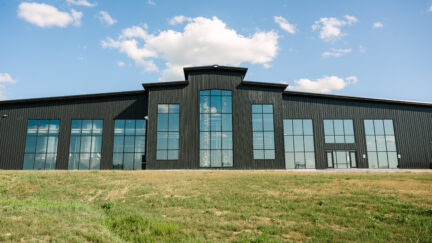
Balcones Distilling Co. is pictured in Waco, Texas. (Photo: Balcones Distilling Co.)
Across Texas sprawls the Balcones Fault, a fault zone named in 1756 by Spanish explorer Bernardo de Mirando y Flores, who was struck by the area’s dramatic stair-step terrain, which he felt resembled a series of balconies.
Perched upon the zone is Waco. A small fish in the massive pond that is Texas, Waco barely cracks the list of the 25 biggest cities in America’s second-largest state. Waco is known for, among other things, Baylor University, Chip and Joanna Gaines’ Magnolia Market shopping complex, the Dr. Pepper Museum and, increasingly, whiskey.
That’s thanks to Balcones Distilling, which was founded in 2008 and today operates out of the old Texas Fireproof Storage Building, an unassuming, industrial brick building in downtown Waco that once protected and stored all manner of consumer goods, like clothes, jewels and furs. Today, it holds a different valuable commodity: whiskey.

Some vault doors from the original Texas Fireproof Storage Company, such as this one, remain in the building that is now Balcones’ distillery.
Balcones the distillery took its name from Balcones the fault zone, and the distilling team relates to the geographical phenomenon on a metaphorical level. Balcones is an extensional fault line, which means it was caused by the stretching of the earth’s crust. As Balcones Distilling Spirits Manager Gabe RiCharde, a geologist before his whiskey career, describes it, the line was caused by tectonic plates pulling away from one another.
“We’re sitting on the spot that’s not really where you come from, and it’s really necessarily even where you’re headed, but it’s the transitional space in between,” Balcones Distilling Head Distiller Jared Himstedt said during a dinner at the distillery. “And in hindsight, that seems really appropriate for how we approach doing what we do. We’re kind of always in a space that’s becoming, that’s informed by something that was. But I don’t always know where it’s going.”
This sense of limbo stems from uncertainty — not only the uncertainty of Balcones being a relatively young whiskey brand or even the murkiness surrounding the American single malt category (the type of whisky Balcones specializes in making) in lieu of an official designation from the Alcohol and Tobacco Tax and Trade Bureau.
Perhaps the biggest uncertainty surrounds Texas whiskey, a young industry dwarfed by older, larger compatriots — not unlike Waco next to Texas’ bigger cities. Texas’ first legal whiskey distillery, Garrison Brothers, was founded in 2006 and entered the market in 2010. Only two years younger than Garrison Brothers, the 15-year-old Balcones, which was acquired by spirits giant Diageo in 2022, is something of an elder statesman of Texas whiskey.
To put the category’s youth into perspective, a little over 900 miles northeast of Balcones Distilling lies Evan Williams, Kentucky’s first commercial whiskey distillery, which was founded in 1783.
When compared to a big brother more than 200 year its senior (and that’s without getting into the 12th-century roots of Irish whiskey or 15th-century roots of scotch whisky), the Texas whiskey industry is truly an infant, and being a key building block in something as nascent as the Texas whiskey scene can feel equal parts intimidating and exciting.
“To be a part of a place like Texas that everybody would assume has this massive rich whiskey history, just from like the movies and cattle drives and all that, and there’s actually a pretty big void — to be a part of that is really cool,” Himstedt told Whiskey Raiders in an interview at the distillery. “When the new whiskey regions show up in the world, that’s not a common thing.”
What Is Texas Whiskey?

A panel on Texas whiskey at Balcones Distilling Co.’s 15th anniversary celebration event. Panelists are Balcones Distilling Head Distiller Jared Himstedt (on couch, left), Garrison Brothers founder Dan Garrison (behind couch, left), Andalusia Whiskey Co. co-founder Ty Phelps (behind couch, right) and Ironroot Republic co-founder Robert Likarish (on couch, right).
While a precise definition of Texas whiskey is cloudy (it’s not a category with any sort of legal definition), two things are clear: to be a Texas whiskey, it must be whiskey, and it must be Texan.
The whiskey part is easy; the TTB clearly defines whiskey as a spirit distilled at less than 95% ABV from a fermented mash of grain and bottled at no less than 40% ABV.
While the “Texan” bit is tougher to nail down, the Texas Whiskey Association (founded in 2018 by eight distilleries, including Balcones) has a definition of its own. Via the association, a certified Texas whiskey must be mashed, fermented, distilled, aged and bottled in Texas. The grains can be sourced from anywhere, but everything else about a Texas whiskey has to take place in the Lone Star State.
That’s part of the answer, but it only addresses the technical side of the question. The production process doesn’t truly tell us what makes Texas whiskey what it is.
Defining and understanding a category as young as Texas whiskey is difficult, even for those who make the stuff. RiCharde believes Texas whiskey and in particular Texas single malt often host tropical and stone fruit flavors. Himstedt, a meanwhile, describes Texas whiskey as having “an intensity” about it.
“Texas whiskey just tends to have — it’s almost like a reduction compared to the wine,” Himstedt said. “Everything is just kind of packed in. Even if it’s subtle, nuanced flavors, it’s just kind of a lot in a small area. There’s never a watered down or thin [mouthfeel]. They tend to have good texture, and there just seems to be a lot going on in a very small package.”
Himstedt feels a connection between Texas whiskey and the state’s essence and culture.
“Different places have personality and character, or at least we think they do,” he said. “Over time, Texas was thought about as being a little bold and brash and independent and maybe even a little bit harsh.
“That’s not about people; that’s literally just about the place, and I think the whiskey sometimes shows that, too.”
The Balcones crew paints a picture of Texas whiskey: Big, bold, powerful, viscous, fruit-forward. But why does Texas whiskey taste the way it does?
A clear differentiator for Texas whiskey is terroir.
Just as Scotland’s moderate, drab, cool (and oceanside, in some cases) climate contributes to the flavors and development of its whiskies, most cite the harsh, dry heat and unpredictable weather of Texas as the top contributor to its whiskeys’ distinctive profiles.

Farmer Barry Evans walks through a struggling cotton crop, Oct. 3, 2022, in Kress, Texas. Texas’ climate is hugely impactful on a variety of industries. (AP Photo/Eric Gay)
Beyond the terroir’s effect on spirit aging in barrels, it’s hard to discern what is unique about Texas whiskey, and one reason for that is it hasn’t reached its final form yet. Texas distilleries have experimented plenty with the climate’s impact on aging whiskey, but what about its effect on the growing grains that will one day be mashed and distilled into whiskey?
Another reason it’s so hard to define Texas whiskey is the size of the state. Texas is bigger than France and twice the size of Germany, so naturally, whiskeys from across the state are going to vastly differ across the board.
“Declaring that ‘Texas whiskey tastes like _______’ is a massive reduction to the 50 some odd distillers in Texas,” says Nico Martini, author of the book “Texas Whiskey.” “The only thing they have in common is the arbitrary parameters set by a government over 200 years ago.”
Martini points out that whiskey in Kentucky, Tennessee and Indiana all bear similarities to one another but aren’t lumped together due to state lines.
He has a point; those three states combined aren’t large enough to cover even half of Texas.
What Martini wants to make clear is this: Not all Texas whiskeys taste the same or even alike.
“The distilleries in Texas are as independently minded as the state itself,” he said.
For instance, according to RiCharde, many have cited Balcones as having a “really strong house profile” across its various whiskeys — a hard-to-describe, je ne sais quoi profile. That’s not Texas — it’s Balcones.
Martini echoed a similar sentiment.
“Balcones has a particular note that is pretty pervasive, but I’d argue that’s because of the way they have leaned into the terroir of central Texas and the grain of the panhandle,” he said. “I’d also argue that particular note may not ever be replicable by anyone in a different region.”
Battle of the Barleys: Local Texan Grain Vs. Heritage Scottish Barley
The only grain component in single malt whiskey is barley, and when Balcones began its operations, the industry was so young that the state didn’t have any brewing- or distilling-grade barley to offer, according to RiCharde.
“The scene didn’t exist,” RiCharde explained. “No one was growing. No one really could grow it [or] had the expertise to cultivate it.”
That changed in 2013 with the arrival of Blacklands Malt, which opened shop to aid the rising craft beer industry in Texas. Balcones was among Blacklands’ first customers, and while the pioneering barley producer has since shut down, a new wave of Texan maltsters have cropped up to take its place, including Fort Worth-based TexMalt, from which Balcones sources much of its malt.

Barley from Fort Worth, Texas-based TexMalt. (Photo: TexMalt/Instagram)
Balcones started out making its whiskeys with golden promise, a common variant of barley grown in Scotland commonly used to make beer and whisky. Balcones is enthusiastic about the prospect of transitioning to Texas barley, is already using it in its Lineage single malt and has plans to produce plenty of single malt whiskey made exclusively from homegrown barley.
Himstedt says the Texas barley they use tends to impart notes of apple and pear, while the Golden Promise has more of a stone fruit and tropical fruit profile, along with baking spices like cinnamon, nutmeg and allspice. These latter, spice-laden notes are a negative for Balcones, which doesn’t prefer a spice-heavy profile for its whiskeys; as Himstedt puts it, “We try to keep spice at bay in favor of fruit.”
Beyond the flavors, Balcones is compelled to use Texas barley by a sense of obligation and curiosity.
“There’s also the philosophical shift of: Should we be importing Scottish barley from billions of miles away, or should we do something [local]?” Balcones Distilling Brand Experience Manager Alex Elrod said. “And not even necessarily local for the sake of the ‘L’ word, but we can have a positive impact at pursuing local things in good ways that feel more regenerative or special.”
The Upside to Texas Whiskey’s Youth
If you ask Himstedt, Texas whiskey’s lack of tradition is a plus. Storied distilleries with centuries of tradition from the likes of Scotland and Kentucky have built massive bases of loyal customers who have certain expectations, which can make it difficult to deviate from convention.
“There’s a pretty big disincentive there to [do] some of the things that we’ve played around,” Himstedt said in a video filmed by Balcones for its 15th anniversary. “There’s a blank slate. Nobody has any idea what Texas whiskey is going to be. No one knows what American single malt is going to be; you’ve gotta go do it.”
One could consider the uncharted waters of Texas whiskey terrifying, but Balcones sees it as an adventure.
Just like the distillery situated on that extensional fault zone for which it’s named, Balcones and Texas whiskey are at a midpoint; the past and future are pulling apart from one another, and it’s a mystery where exactly things will end up. But one thing is certain: Balcones is excited for the journey and continuing to get to know Texas and the sort of whiskey its natural elements are inclined to help make.
“We want to know and love a place in how it wants to be loved and how it wants to be known, and not in our way,” RiCharde said. “We’re in Texas, so we want to make Texas whiskey, but it’s hubris to think that we know what that is.”
Follow The Daily Pour:
About The Daily Pour
Founded by Dan Abrams, The Daily Pour is the ultimate drinking guide for the modern consumer, covering spirits, non-alcoholic and hemp beverages. With its unique combination of cross-category coverage and signature rating system that aggregates reviews from trusted critics across the internet, The Daily Pour sets the standard as the leading authority in helping consumers discover, compare and enjoy the best of today's evolving drinks landscape.