China’s Top Liquor Brand Reports First Sales Drop in Over Two Decades

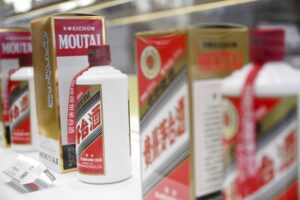
Several bottles of the Chinese liquor brand Kweichow Moutai stand in the display case of a store. (Photo by: Johannes Neudecker/picture-alliance/dpa/AP Images)
Kweichow Moutai, an icon of Chinese culture and one of the largest spirits companies worldwide, has reported its first annual profit drop since it was listed on the Shanghai stock market in 2001. Analysts speculate that the surprise dip may be attributed to a government crackdown on civil servant spending and plateauing interest among younger consumers.
The company posted a 2025 revenue of 168.8 billion yuan (USD $23.3 billion), down 1.2% from the prior year, while net profits fell 4.5% to 82.3 billion yuan ($12.07 billion). Both fell well below market expectations, plunging Kweichow Moutai’s stock price by 3.8% the day of the earnings report’s release.
The Guizhou-based distiller specializes in baijiu, a millennium-old liquor typically produced using fermented sorghum grain. Baijiu accounts for a staggering 94% of spirits consumption in China, handily making it the world’s most consumed liquor by volume.
To call Kweichow Moutai a sales juggernaut within its category would be an understatement. Responsible for a reported $24.17 billion in revenue in 2024, it is indisputably China’s most famous and best-selling liquor brand. The distillery currently ranks 156 on the Fortune 500 China list and is the largest non-technology company in its home country.
According to the company, the profit drop was mainly due to adjustments in the “product mix” of its soy sauce aroma liquor series. Baijiu styles are distinguished not by their flavor profile — of which there are many — but rather by their aroma, the four most common being light aroma baijiu, rice aroma baijiu, strong aroma baijiu and sauce aroma baijiu. Kweichow Moutai is best known for its 53%-ABV sauce aroma liquor, known as Feitian (“Flying Fairy”) Moutai.
Political forces may also be afoot. In 2025, the Chinese government announced sweeping restrictions on its over 40 million civil servants, banning them from lavish banquets and other forms of perceived wealth-flaunting.
Baijiu sales have likely taken a hit from the crackdown. Kweichow Moutai is hugely popular among the country’s government officials and upper class, often making high-profile appearances at diplomatic events. Richard Nixon, Ronald Reagan and Barack Obama have all famously been served Kweichow Moutai during official visits, with former U.S. Secretary of State Henry Kissinger once remarking, “I think if we drink enough Moutai, we can solve anything.”
Follow The Daily Pour:
About The Daily Pour
Founded by Dan Abrams, The Daily Pour is the ultimate drinking guide for the modern consumer, covering spirits, non-alcoholic and hemp beverages. With its unique combination of cross-category coverage and signature rating system that aggregates reviews from trusted critics across the internet, The Daily Pour sets the standard as the leading authority in helping consumers discover, compare and enjoy the best of today's evolving drinks landscape.