‘We Need More Time’: Farmers Sound Alarm on Looming US Hemp Ban

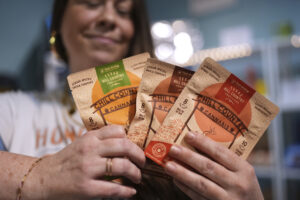
Employee Savannah Gavlik displays THC products at the Dope Daughters dispensary in Austin, Texas. (Photo: AP Photo/Eric Gay)
Less than a decade after the 2018 Farm Bill sparked a wave of optimism and investment, the federal government is slated to ban the vast majority of hemp products by year’s end.
Hemp, originally defined as goods with less than 0.3% THC by dry weight, has ballooned into a $28.4 billion industry responsible for a reported 328,000 jobs. It’s the workhorse behind all of those gummies, drinks, tinctures and flower that have appeared out of seemingly nowhere on convenience store shelves across the country. If the ban takes effect on Nov. 12, it’s estimated than 90% of non-intoxicating goods will be erased from the market.
The current prevailing theory is that the ban will be replaced by a federal regulatory framework, ushering out the old era of so-called “bad actors” in favor of a cleaner, greener and safer market. Angus Rittenburg, co-founder of THC drinks brand Wynk, recently told us that the law is a “blessing in disguise.” He believes that policymakers and hemp producers will come to a mutually advantageous outcome, working together to ban improperly labeled products and set firm age of purchase laws akin to alcohol or tobacco.
Rittenburg is most likely correct. But his prediction is far from a guarantee — especially for farmers who have staked their livelihood on the crop and now have everything to lose.
At the end of March, the U.S. Hemp Roundtable held a virtual conference in which hemp farmers from across the country shared insights about the current state of their industry. Ryan Eakes, managing director at the largest cannabinoid farm in Colorado, was the first to chime in.
“All of us want sensible regulation,” Eakes said. “The loophole definitely needed to be closed, but it needed to be a surgical adjustment, not a sledgehammer, which is what they effectively used. We need more time to educate the people who are making decisions for us.”
A Farmer’s Perspective
The story of American hemp begins in Kentucky. The Hemp Farming Act of 2018 was spearheaded by Senator Mitch McConnell, who pitched the legislation as a lifeline for his home state’s agricultural economy. So instrumental was McConnell that he reportedly coined the hashtag #HempFarmBill, per the American Military News.
Much changed in the ensuing years. Hemp products evolved into a multi-billion-dollar industry, and McConnell — who had envisioned his law for industrial use, not “intoxicating” use — changed his tune. It was McConnell who closed the loophole in 2025, leading to clashes with fellow Kentucky Senators Rand Paul, James Comer and Andy Barr, who have emerged as some of the industry’s most vocal proponents.
Abram and Asa Phillips are two of the farmers caught in the crossfire. The father and son duo (fourth- and fifth-generation farmers) are owners of Phillips Farms in Owen County, Kentucky. They talked with lawmakers in D.C. in the months leading up to the federal ban passage but say their input was left on the cutting room floor.
“Here in our county, we’ve got 786 acres of hemp. It’s a big economic thing,” Asa said. “The farmers were counting on $7 to $10 million coming in from this crop this past year. The labor part of it is also important – we had about 15 H2A boys [federal visa holders] employed last year, and we spent about $2.2 million on labor, just ourselves, not counting the other farmers in our county.
“Out of pocket, it costs $2,500 to $7,000 an acre to grow the crop. Farmers can get in a pretty big mess pretty quickly if they don’t watch what happens,” Asa continued.
According to Asa, the price of hemp has cratered over the past half year, dropping below that of tobacco. If farmers could pack their bags and plant a new crop overnight, then the hemp ban would only be a matter of switching to corn, soybeans, wheat or anything else that could get margins up by next season.
But farming takes time — the kind of time that careens toward the eleventh hour when you’re staring down a possible prohibition. In addition to selling last year’s harvest, Phillips Farms must now contend with seeds in the ground that may or may not prove to be a critical miscalculation.
“It’s very rare for a farmer to just wake up one day and say, ‘Alright, let’s do it!,'” his son Abram said. “You have to dedicate lots of time and effort; it’s a lot of deliberation. Before harvest starts, you’ll be planting for next year. Before you even start your crop, you’ll have planned out what you’ll do if and when you make profits.
“We’re not asking to get filthy rich. We’re just asking for a stable, reliable market, where anyone who will do the labor and the work, who is worth their salt, will make money at it. But with prices sitting at $2 a pound or so, there’s no good money.”
Ryan Eakes, managing director at Typhoon Farma in Montrose County, Colorado, says his business has already planted its 2027 hemp crop. Whether or not that risk will pay off with a reward is yet to be seen. Equally troublesome, it’s unclear what the roadmap for American hemp will look like if comprehensive regulations are passed. States like Colorado have already proposed bills that would restrict hemp legalization to beverages, while others are turning their sights to weaker cannabinoids like CBN and CBG. There’s a patchwork of different options on the table, and they all mean different things to farmers.
“We’re a dedicated hemp farm,” Eakes said. “It’s not like we have corn or hops or something else to fall back on. All we do is hemp. If we don’t develop the market overseas and the U.S. market drops by 90%, 95%, chances are we won’t be growing next year.”
Overseas markets may become a stepping stone for the future of American hemp (two weeks after the roundtable, Eakes attended his first overseas trade show in Berlin, hoping to discuss business development from a farming perspective). Germany, Canada, South Africa, Uruguay and Chile are among those friendliest to recreational products, while the list of countries with medical exceptions reaches into the high dozens.
Exports, however, are only half of a solution. Ken Meyer, co-founder of Complete Hemp Processing in South Dakota, says that the root of the problem begins within the U.S., where investment has dried up in the once-fertile hemp fields.
“‘There’s a ban’ — the insurance people hear that, the banking people hear that, and it just puts a chill on any kind of business,” Meyer said. “There’s hardly any financing available to expand and continue these kinds of operations because of uncertainty in the federal government.”
Nothing will change until a solution is reached on Nov. 12. With little more than six months on the clock, the likelihood of a fast resolution seems all but impossible, leaving farmers with unanswered questions, mountains of unsold crop and stalling funds.
The U.S. Hemp Roundtable is asking for a two-year extension on the moratorium ban — a window that it says will give “lawmakers, regulators and industry stakeholders critical time to advance a responsible, bipartisan, and comprehensive regulatory framework.”
According to Meyers, the alternative is nothing short of throwing $13.2 billion in wages under the bus.
“The exciting opportunity of hemp is to do local, rural development,” Meyers said. “At our location, we’re in an unincorporated village of about 50 people near a town of 6,000 people. And we’ve put up a $4 million processing facility and have paid out hundreds of thousands of dollars to farmers who can now have hemp in rotation alongside corn and soybeans. And the byproducts coming from our hemp stock processing facility are being sold in the U.S., so we’re supplying the domestic market too.
“In agriculture, we’re just excited to have been given the opportunity of hemp in the last farm bill. A lot of people have invested a lot of money and a lot of time; they’ve been really creative and brought new business and new money to the country. It seems unprecedented that we just pull the rug on that. We’re asking for more time so that we can work out the kind of compromises that can be put in place.”
Follow The Daily Pour:
About The Daily Pour
Founded by Dan Abrams, The Daily Pour is the ultimate drinking guide for the modern consumer, covering spirits, non-alcoholic and hemp beverages. With its unique combination of cross-category coverage and signature rating system that aggregates reviews from trusted critics across the internet, The Daily Pour sets the standard as the leading authority in helping consumers discover, compare and enjoy the best of today's evolving drinks landscape.